Thursday, April 26, 2018

Push Students to Work like Mathematicians with Practice Standards

Practice standards come from assessments that measure progress towards one or more of the Common Core Standards for Mathematical Practice or other 21st Century Learning Skills. I typically assess these with with collaborative tasks or projects and grade them with a rubric. The tasks I use vary widely between formal performance tasks, group presentations, debates, modeling tasks, games of taboo and pictionary, error analysis, and more.

My rubrics also vary. The practice standard rubrics are out of 10 points, like my content standard rubrics, but the rows depend on the specific task students are doing and the skill I am trying to assess.


One thing that has become consistent is when I assess practice standards. I like to start units or topics with a collaborative anchor task that the rest of the unit can relate back to. I don't grade this anchor task, but I do give students feedback. Then, we go ahead with the regular lessons. Towards the end of the unit, I have students work on a task that is similar to the anchor task, and this time I grade it with practice standards.This has a few benefits:

  • Student's level of anxiety is lower because they have already seen a similar anchor task
  • The teacher can get a clear assessment of where they are at with the practice standards because content standards shouldn't be holding them back
  • A collaborative task can serve as a good review for a summative assessment 
  • Using similar tasks as bookends on a unit gives students a chance to reflect back and see how the mathematics they learned allowed them to dig deeper into a specific problem.

Wednesday, April 25, 2018

Focus on Assessing Concepts with Content Standards

I hate nickeling and diming students for points. I hate having students come back to me after an assessment and argue why I took off two points instead of one. I hate putting one grade on the front of a test, even though there were many skills that students needed to know to be successful. So, here's what I now do:

Before I start a unit, I identify the skills and knowledge students will need to be successful. I write them as student friendly "I can..." statements. These become my content standards, and I save these in a spreadsheet for later years. I also number them. A few are below.

Standard 10: I can specify a series of transformations that carry one figure onto another.
Standard 15: I can apply the Pythagorean Theorem to solve a variety of geometric problems.
Standard 21: I can find and interpret the slope of a line in a variety of representations

Then, I take my old tests and quizzes and place the assessment items (i.e. questions) into groups based on which of the standards they're assessing. Ideally, I have just enough items to allow me to accurately determine if a student has mastered that standard. Sometimes I have too many or not enough items, and I fix that by deleting some or writing more. For some reason, this often comes out to exactly one page. Below is an example.


Notice that there are no point values on each question. Instead of grading each question, I give written feedback. Then at the top, I give a holistic score at the top out of 10 points. Below is the rubric:

10/10 Above Mastery: you have mastered the skill and correctly applied it to a challenging and novel situation
9/10 Mastery: you have demonstrated a full understanding of the concepts involved, have clearly showed all steps of your reasoning, have used notation correctly, and have no errors
8/10 Some Procedural Errors: you have demonstrated a full understanding of the concepts involved, but you may have made a procedural error that was not related to this standard 
7/10 Some Conceptual Errors: you have demonstrated partial understanding, but are unclear on one minor concept.
5/10 Weak Understanding: you have attempted to answer the question, but are unclear about multiple minor concepts, or one key concept. Student should retake.
0/10 No Understanding: You left the page blank or made no mathematical attempt. Student should retake.

I once had another teacher jokingly rephrase it this way:

10/10 Above Mastery: Wow!
9/10 Mastery: Yes!
8/10 Some Procedural Errors: Yes, but…
7/10 Some Conceptual Errors: Kinda…
5/10 Weak Understanding: Not really.
0/10 No Understanding: Check for a pulse!

Why 10 points? 

Well, I've tried grading with the more common 4 or 5 column rubrics, but there is often confusion that a 3/5 means the same as a 60% in a 100-point grading system. That's a battle I kept having to fight with students and parents. However, by grading out of 10, students can easily match their grade up with the A, B, C, D, F format of most schools. I don't necessarily like the system, but I would rather my students not be confused.

What's the 10/10 all about?

Most standards based grading systems advocate for no extra credit. But, in classes with many different ability levels, teachers often feel the need to give students who go above and beyond some sort of credit. So, the “extra credit” is hidden in the 10/10. Students that demonstrate mastery still receive 9/10, but the challenge is there for students that want it. And, if students are unable to get the challenge question, they will still get a 9/10 - not a far way to fall.


What if a student gets the challenge question, but has mistakes elsewhere?

If a student had a minor computational error, but they got he challenge, I write "8+1/10" on their paper. the 8 is for the minor computational error, and the +1 is for the challenge question. They will end up with a 9/10 in the grade book, but I also put a note on the assignment. It's not a perfect solution, but gets the point across.

Where's the 6/10?

In my school, a 60% means that a student is just barely passing the course. Unfortunately, that makes it a very ambiguous grade for students. Does it mean that they skills and knowledge they need to succeed? Or, does it mean that they don't have the skills and knowledge, but they did just barely enough work to pass? To avoid confusion, I don't give 6/10. (see my first norming activity for more information)

Where's the 4/10, the 3/10, the 2/10, or the 1/10?

I allow students to retake assessments. If there is no understanding evident, then I need to strongly encourage the student to study and retake the assessment. I feel giving a 3/10 sends mixed messages to students and takes longer to grade.

How much time does it take to grade assessments this way?

I have found grading this way is faster than grading by question. That's because I don't perseverate over how many points I am allotting per question. I've also found I give better written feedback because I'm looking at the standard as a whole.

How many standards are on one test?

The sweet-spot for me seems to be three or four. I once did six, and it took too long. Just assessing one seems like a job for an exit-slip. We do give final and midterm exams, and for those I typically have six to eight standards.

So, how do you put grades into the grade book?

I put in one grade per standard, so students can see their level of mastery on different standards. I never average together all the standards, and I don't encourage students to do it either.


What does this mean for formative assessments?

I have started labeling formative assessments, independent practice, and collaborative tasks with wither the "I can..." standards or the number of the standard. That way, students can see how learning activities, formative assessments, and summative assessments all relate to each other. It also helps students find resources when studying or retaking assessments.

Do you retest the same standard throughout the year?

I reserve the right to retest any standard at any point during the year. In reality, I only retest key standards, ones that constitute the major work of the grade. Our school gives midterm and final exams, and the standards on those have all been tested before.

Tuesday, April 24, 2018

Three Types of Standards

I've done a lot of thinking about all the ways that students get feedback, including formal assessments, informal comments, and personal reflections. When you sit down to list them, there are quite a lot: written feedback on exit slips, verbal feedback from peers during group work, passing comments from me as I circulate around the room, a number in red at the top of a test, and so many more. Yet, I think I've settled on three general buckets for these types of feedback, or at least for the feedback I want to record as a grade. Below are the three buckets with some explanation to them. Click each one to find out more.

Content Standards

Content standards come from assessments that measure progress towards one or more of the Common Core Math Content Standards or any math-specific standards. This could also be called the “traditional” math grade. Typically, content skills and knowledge are not very transferable to other courses, except ones that directly use math content (e.g. physics).

Examples of assessments include exit slips, quizzes, tests, and content-specific tasks. There may be (and often is) more than one content standard per assessment. I typically assess three separate standards in one sitting.

Practice Standards

Practice standards come from assessments that measure progress towards one or more of the Common Core Standards for Mathematical Practice or other 21st Century Learning Skills. These could be seen by some as an “application” grade, but should could (and should) include all standards for mathematical practice such as justification and precision. Typically, these skills are transferable to other courses and other fields.

Examples of assessments include error analysis, collaborative group activities, modeling projects, and any task intended to measure the mathematical practices. Just like content standards, you could assess multiple practice standards in one assessment. In fact, many of my collaborative tasks include both content standards and practice standards.

Scholarship Standards 

Scholarship standards represents a student’s progress towards the transferable qualities of being a productive student. This includes "soft skills" such as executive functioning skills, punctuality and preparedness, working flexibly, self-monitoring, and reflection. Typically, these skills are transferable to all other academic settings. One example of a scholarship standard assessment is a personal reflection using a rubric.


How these Interact with a Traditional Grading Scheme

Unfortunately it can be hard to pull these three types of standards apart in the grade book, especially if you're working in a traditional system with an online grade book that averages all the grades together to get one final grade. If that's your reality, I suggest setting up your online grade book with these three buckets as categories. Then, when progress report or report cards get sent out, simply print out a category report. Then, you can:

  • Send it home to parents so they can understand their student's specific strengths and areas for improvement
  • Conference with the students one-on-one so they understand the connection between the categories (e.g. scholarship standards have an impact on content standards)
  • Use it to help write comments on report cards (e.g. students with high practice standard scores often get something like "Works like a mathematician by collaborating with others, attending to precision, and persisting through challenges"

Now, I'm pretty sure this is all stolen. I vaguely remember reading about categorizing standards years ago, but I can't remember the source. So, if anyone can point me in the right direction, I would be happy to give credit where credit is due.

Monday, April 23, 2018

Norming our Personal Philosophies of Grading

Standards based grading is all about assessing what we value. Whether you are doing this by yourself or with a team of teachers, it's important to have a personal philosophy of grading. Since every classroom is different, you'll need to adapt your standards based method to meet the needs of your students. A philosophy can help you do that. A philosophy can also give you something to fall back on when you're challenged by a student or parent.

So, here are three activities that tend to help:

1. What does it mean for a student to pass your class?

In some places, passing is a 60. In others, it’s a 70. Think about what it means for a student to barely pass your class for the year. Then, think about what it should mean for your student to pass for the year.


2. What is the purpose of a final grade in your class? A card sort.

Below are a list of purposes a final grade might have. Number the following purposes from most important to least important. Alternatively, you might just circle the top three purposes. Note that this activity is best done as a card-sort with slips of paper.
  • Feedback About Achievement for the Student
  • Feedback About Achievement for the Parent
  • Feedback About Effort & Behavior for the Student
  • Feedback About Effort & Behavior for the Parent
  • Informing Daily Instructional Planning
  • Informing Long-Term Unit Planning
  • Informing Intervention or Support Teachers
  • A Motivation Tool for Students
  • A Prerequisite to Pass to the Next Level Class
  • A Factor in Entrance into College
  • To contribute to their GPA and Class Ranking


Once you rank, think about the following questions:

  1. What were your top three purposes? Why?
  2. What were your bottom three purposes? Why?
  3. How could we change the way we assess to target the most important purposes?
  4. Are there any purposes that might be inappropriate to include in a final grade, but that are still important? How can we incorporate those into our classroom practice?

3. What’s in a grade? Assessing what we value with colored manipulatives.

Since standards based grading is all about assessing what we value, let’s norm our grading system. I have created four large categories that most graded assignments in our class can fit into with descriptions below. In a true standards based system, we standards would be reported separately. Unfortunately, many schools still use a traditional model that requires us to give each student one final grade at the end of each marking period.  


Typically, this activity would be completed with a pile of red, blue, green, and yellow chips that correspond to the categories. Each of chip represents 10% of your ideal total grade makeup for your class. Your job is to take 10 chips that best represent how you would create your final grade. If you're on paper, just shade in 10 squares.


Content Grades: Blue Chips

This grade represents a student’s progress towards mastery of content standards. This could also be called the “traditional” math grade. Typically, these skills are not very transferable. 

☐   ☐   ☐   ☐   ☐   ☐   ☐   ☐   ☐   ☐

Practice Grades: Red Chips

This grade represents a student's progress towards the math practice standards. These could be seen as an “application” grade. Typically, these skills are transferable to other fields.

☐   ☐   ☐   ☐   ☐   ☐   ☐   ☐   ☐   ☐

Scholarship Grades: Green Chips

This grade represents a student’s progress towards the transferable qualities of being a “productive student”. Typically, these skills are transferable to all other academic settings.

☐   ☐   ☐   ☐   ☐   ☐   ☐   ☐   ☐   ☐

Completion Grades: Yellow Chips

This grade represents the completion of a specific task. Often an “all or nothing” grade to elicit a behavior.

☐   ☐   ☐   ☐   ☐   ☐   ☐   ☐   ☐   ☐

Once you are finished, turn and talk to your partner about the following questions:
  1. What categories have the most or least number of chips? Why?
  2. Does our ideal system match our current system? What would we need to change?
  3. Does your grading system reflect your classroom practice? In other words, if you allocated 50% of your grade to practice standards, does 50% of your classroom practice include the mathematical practices?
  4. Are there any aspects that would be inappropriate to grade, but that are still important? How can we incorporate those into our classroom practice?

Sunday, April 22, 2018

Building a Flexible Standards-Based Classroom within a Traditional School Setting

Hi, I’m Bob. I’ve been using standards-based grading (SBG) within a traditional grading setting for five years. I’ve done it at two schools, in two different environments. I’ve also worked with a grade-level team to make the transition. However, in every environment I've been in, I'm either the only or one of the only teachers to use SBG. As a result, I've had to bend some of the "rules" of SBG. I like this quote from Frank Noschese:

A traditional system done in the spirit of SBG is much, much better than an SBG system done poorly.

There are some great resources for making a whole school shift to standards based, but this is not one of them. These resources are aimed at teachers who want the benefits of standards based grading, but who work within a traditional grading system.

What do I mean by a traditional school? I mean a school where...

...grading software allows for points, or maybe category weights. No standards.
...assessments are named in general topics like “Quadratics”, points are assigned to each question, and the student gets one score on the top
...most assignments are viewed out of 100% and students rush to a calculator to find out that 5/7 is a 71%
...the end of the year grade is either out of 100, or A/B/C/D/F, and a GPA is used
...classes are tracked, and perhaps GPA is based on those tracks (e.g. honors students can get a higher GPA)
...it is encouraged that certain behaviors (e.g. homework completion, participation) are scored by completion
...there is no scholarship or participation grade separate from the letter grade
...most stakeholders want to see lots of grades in the grade book and don’t want you waiting for a summative to put in a grade
...textbooks and worksheets are used often

So, how do I work around these constraints? Click below to find out!

Norm your personal philosophy of grading

Think about three types of standards

Focus on assessing concepts with content standards

Push students to work like mathematicians with practice standards

Encourage academic habits and reflection with scholarship standards

Give students multiple opportunities to practice

Encourage and facilitate growth

I also have some slides that I use when I present. Find those by clicking below:

2017 - 2018 Slides

I begged, borrowed, and stole from a number of great people. Click below to read blog posts and articles from a number of talented and thoughtful people!

Frank Noschese
Matt Townsley
Dane Ehlert
Dan Meyer
John Stevens
Sam Shah
Matt Vaudrey
Dylan Kayne
Daniel Schneider
Bruce Jackson
Anna Blinstein
Marissa Walczak

Saturday, November 25, 2017

An Autopsy of a Sophomore Statistics Unit

This year, we flipped our sophomore geometry class around. Typically, we end the year with a statistics and probability unit, but this year we started with it. In fact, we extended the units from the end of August all the way until Thanksgiving break. Our beefed up units included:
  • Creating data displays
  • Probability using Venn Diagrams and two way tables to find unions, intersections, and conditionals
  • One variable measures of center, spread, and shape
  • Measures of location (z-scores and percentiles)
  • Experimental design and survey methods

There were many reasons we made the change, but here are a few:

  • Connecticut is using the SAT as its high school accountability test, and it has a fair amount of statistics on it (and very little geometry)
  • Statistics has been the last unit in our districts 6-8 curriculum, and we all know what happens to units at the end of the year...
  • We used to have 1-var stats and linear regression in algebra I, probability in geometry, and polynomial regression in algebra II, but teaching everything separately felt very disjointed.
  • Our department generally agreed with Arthur Benjamin's ideas about teaching statistics.

Now for the autopsy (complete with emojis)...

😒 It was a struggle for our geometry teachers to change gears at the start of the year. We found that many of the routines that work in geometry don't work as well with statistics. I have typically used a Which One Doesn't Belong to start every geometry class, but I found it very difficult to find or make ones that worked in statistics. Over time, I found that other routines such as Would you RatherClothesline Math, and some 3-act tasks were better suited to starting a lesson.

😩 The shift in content was also tough for teachers. At our school, statistics is typically offered as a senior year course, and our 9th and 10th grade teachers hadn't seen some of the content in years. Remembering how to calculate z-score took a minute; remembering how to teach the meaning behind it took longer. Shout out to the teachers who provided resources that made it so much easier:


😁 On the other hand, students felt much more at ease as compared to previous years. We have previously started the year with coordinate geometry, which relies heavily on skills from algebra I.  I've started the year with Jo Boaler's Week of Inspirational Math for the past three years, but students that didn't fare well last year see the writing on the wall and begin to withdraw early. Starting with statistics circumvented that issue and promoted more of a growth mindset.

😃 Starting with statistics also felt natural, because at the start of the school year you're trying to learn more about your students. Those student surveys and "getting to know you" activities suddenly had more of a purpose. It felt natural to ask students what town they lived in (we're a magnet), then ask how long they rode the bus to get to school, then make a histogram of those times, and finally look at the center and spread of the data.

😏 Staying with statistics for an extended period of time let us talk about social justice issues. For example, after looking at the bus ride data we were able to have an informed discussion about the impact of magnet school busing on our students. Unfortunately, these conversations tended to be limited to one lesson. I would love to have students explore social justice issues further, but I'm not quite sure how I would go about it, if my sophomores are ready for that, or if there is enough time.

😓 Speaking of not enough time, we're now in a situation where our normal geometry curriculum is compressed by six weeks. Since the SATs don't focus on geometry, most higher-ups doesn't see an issue. However, I know that our team of geometry teachers will need to start picking and choosing what topics in geometry we can spend less time on. Wish me luck!

The conclusion: the stats unit will live to see another year!

Saturday, October 14, 2017

Human Box Plots

Class walks in.

"Hey everyone. I put some marks on the floor. Try to stand in the right spot according to your height."


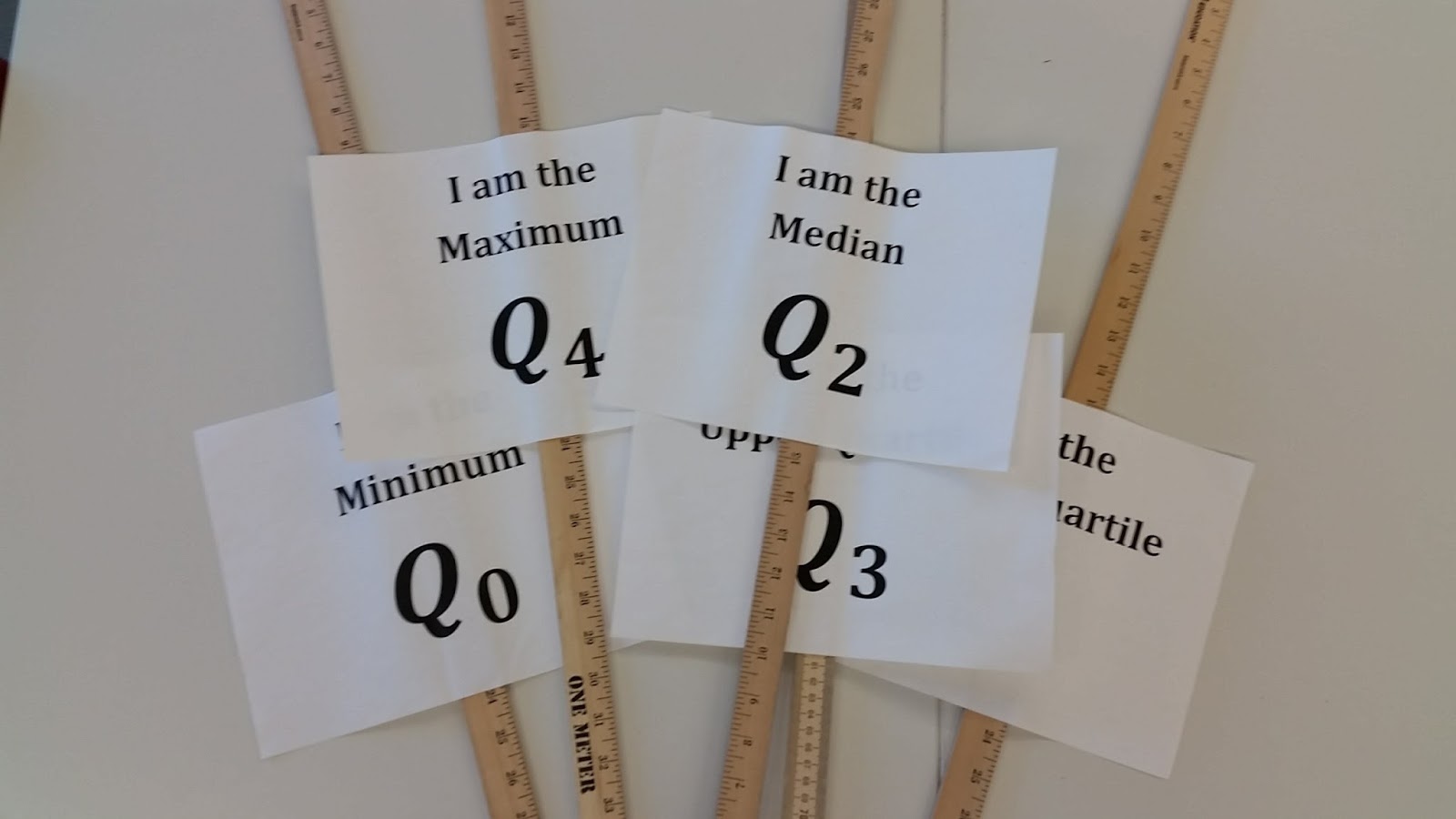
"Oh yeah, I made these too. Figure out who should hold these. I'll just wait over here."


"Can we make it look a little more 'box-plotty'? Yeah, like that. Smile!"

Someone moved just before the picture. 
Can you find the error?

Besides this being a goofy team building activity, it provided a good reference point for students to understand how boxplots work: There should be (roughly) the same number of people in each quartile. Small quartiles don't mean there are less people with that height; it means that the same number of people are crammed into a smaller range. You can see the girls peeking through in the middle. Big quartiles don't mean there are more people with that height; it means that there are the same number of people spread out in a bigger range. Just look how much space the girl in red off to the right has! Every time a student had a misconception about box plots, I reminded them of this activity.