Our high school places much more emphasis on grade level teams than departments. To that end, all of our teachers are attached to a specific grade level, and our core teachers typically teach only students from that grade. For example, I may teach geometry and algebra II, but my classes are all sophomores, with the exception of three students. Each grade level team has a team leader (aka Dean), and any non-urgent issue should pass through the grade level team leader before going to administration. Moreover, our schedules are specifically designed such that the entire core team (Math, Science, English, Social Studies, Language, and SpEd) has the same prep time every other day for 90 minutes, with the intent that some of that time will be used for meeting.
This year I took on the role of team leader, in a school so new that we hadn't graduated a senior class, with a sophomore class that I been warned about. These are five of the many things I learned.
1. Preparation.
It wasn't until December that I started planning for our week long class field trip in the spring. It wasn't until January of my first year that I realized that I had never been trained in our schools academic intervention protocol. And, it wasn't until April that I realized that not every member of our team was taking accurate data on our students. All three issues blew up in my face in one way or another.
I suppose there isn't a MTBoS or a "First like Third" for deans and grade level leaders. I've talked with @Borschtwithanna and @jaz_math about their experiences transitioning into leadership roles, and we had a productive meeting at TMC16. But, with all the nuances and confidentiality issues, it's difficult to be open about your experiences. For now, the best preparation is experience.
2. You won't know how to deal with everything, and that's okay.
I thought I had been called some pretty nasty names and seen my share of odd behaviors. But, when you lead a group of teachers, the issues in their classroom suddenly become your issues too. Issues that you would normally prevent before they arose suddenly land on your desk without any forewarning. This is probably the toughest part of my new role, and by working through it, I have gained I have a newfound respect for my administrators. There were many cases I had no idea how to deal with, and many things I have to learn from my principal. But, I've learned to take things as they come and understand that I can't possibly have control or even knowledge of all issues in all the classrooms on my team. In this case, it looks like experience is the best preparation.
3. Perhaps there should be a fine line between teacher and administrator, but it's often blurred.
Often, teachers on my team would come to me complaining about a student. I had to learn to step back from the break room gossip and respond in a way that would be constructive for the teacher. At the same time, I tried to develop a very friendly rapport through consensus building, and only making top-down decisions when absolutely necessary. Thankfully, everyone on my team had been teaching for at least a few years and had their stuff together. They let me dance between the teacher, administrator, and friend lines with very few issues. Next year I'll probably have at least a few different teachers, and the dynamic will shift.
4. There are three other grades in the school: use them to your advantage.
At the minimum, it is important to ensure that all the grades are on the same page clerically (timing field trips so they don't overlap, coordinating special events) and academically (common rubrics, similar good assessment techniques, etc). However, I learned that leading the sophomore team requires more. It is important to reach out to the seniors and ask for students to TA a sophomore class during a study hall. It is critical to have an assembly where Juniors starting their college applications reflect publicly. And, it is well worth the time to have sophomores set the example for our new freshman by leading norming sessions. A high school has a natural hierarchy, and it's important to embrace it.
5a. They're just kids.
Procedures are important. Rules have their place. But, kids are kids and everyone has their bad days. When I started the year, I thought I would tow the line and hold up high expectations. But, when I started to see students with difficult home lives and exceptional circumstances, I began to bend. I had always seen the the typical issues students might face in a Title 1 school, but instead of just seeing each student for 90 minutes every other day, I saw a much more holistic version. So, I bent. You're family can't afford a uniform? You can be out of dress code until we figure something out. Parents working and can't get you to school? I guess we'll have to excuse the tardies. Couldn't do your homework because you were working? Just hand it in next week. And then the slide started...
5b. But, they're still kids.
It turns out that both students and teachers need structure. Bending a rule for a few students can quickly turn into breaking it for everyone, especially when other teachers are looking at you. It's difficult to understand a situation without context, and I understand how seeing your team leader make an exception for a student from down the hall can be easily misunderstood as a rule change. We especially had issues with a high number of nuanced and ever changing rules (dress code, tardy procedure, code of conduct). By the end of the year, nobody knew exactly what the expectations were because they had changed so frequently, either explicitly or by a sort of implicit "let's just follow what Janes is doing and hope for the best". And, as we all know, once the teachers start being inconsistent, the students can run the show.
I suppose my resolution is to work with my administration to set a shorter, unchanging, and more enforceable set of rules and expectations for the sophomore students. In addition, I'll need to work with the entire team of teachers to develop a common understanding and a uniform procedure when students need to circumvent those rules, if only for a day. Building rapport and background with students is key in order to recognize those days when a specific student needs a break.
All in all, a long and exhausting year, but one that taught me a great deal about myself, my teachers, and the students we work with every day.
Welp...
On to year two!
Thursday, June 30, 2016

Thursday, March 31, 2016
Whiteboards for Everyone
This year, I've turned into the Oprah of whiteboards: you get a whiteboard, and you get a whiteboard, and you get a whiteboard. Everyone gets whiteboards! That hang on the walls, but can move!
Over the summer, I learned about vertical non permanent surfaces (VNPS) from Alex Overwijk, which he has explained in a blog post titled Vertical Non-Permanent Surfaces and Visible Random Groupings. The research on VNPS comes from Peter Liljedahl of Simon Fraser University, and is explained fully in his paper Building Thinking Classrooms: Conditions for Problem Solving. Both the blog post and the paper are worth reading fully, however here are the main definitions:
And the main take-aways:
So, it seems like hanging whiteboards are the way to go!
Some classrooms have whiteboards on multiple walls, but I did not. In fact, I didn't want one large whiteboard per wall. I thought it would be better if students (or groups) had their own large, vertical whiteboard that could be moved or re-sequenced as needed. Individual whiteboards would also fit nicely into a 5-Practice Routine framework.

To that end, I created 2 ft by 2 ft 8 in whiteboards out of Thrifty White Tile Board. They come in 4 ft by 8 ft sheets, so having the people at home depot cut it into 6 pieces isn't too bad. And, they're about the same size as the Post it Easel Pads (and much cheaper in the long run). I bordered each with black duct tape, and drilled two, 1 in diameter holes in the top, using a cardboard template to drill in the same location each time. The center of each hole is about 2 in from the top and each side. Lastly, the boards are hung with a bulk pack of Command Medium Hooks. I ended up with about 18 boards in total. In the picture below, they haven't been hung up yet, but a better picture is above.

The great thing is that I've found more ways to use them that I thought possible. I've incorporated them in timed-practice, whiteboard speed dating, stations, find the error problems, anchor charts, and more. Even better, I can put these boards on a chair and use it to teach a mini-lesson to a small group of students.

Recently, I've had the kids getting more involved. They've been walking over to a board in the middle of class to explain an idea. I find them teaching each other on the boards between classes. One student has started taking pictures of his boards with a cam-scanner app as a way to save his notes. Not too bad for a few dollars at Home Depot.


She also added a Calculator Caddy using the same command hooks. Now everything is on the wall!

Over the summer, I learned about vertical non permanent surfaces (VNPS) from Alex Overwijk, which he has explained in a blog post titled Vertical Non-Permanent Surfaces and Visible Random Groupings. The research on VNPS comes from Peter Liljedahl of Simon Fraser University, and is explained fully in his paper Building Thinking Classrooms: Conditions for Problem Solving. Both the blog post and the paper are worth reading fully, however here are the main definitions:
- Vertical surfaces are ones that hang on the wall and can be seen by everyone, such as chart paper or wall-mounted whiteboard.
- Horizontal surfaces are ones that are placed on a desk, like a worksheet or individual whiteboard.
- Permanent surfaces such as chart paper or worksheets cannot be erased.
- Non-permanent surfaces can be erased or modified, and include chalk boards or white boards.
And the main take-aways:
- Students who work non-permanent surfaces tend to start working more quickly and tend to persist longer than those working on permanent surfaces. They also tend to discuss their ideas more with their peers. This may be because non-permanent surfaces allow for corrections, and enable cognitive risk-taking.
- Students who work on vertical surfaces tend to share ideas with students in different groups (called mobility in the study).
So, it seems like hanging whiteboards are the way to go!
Some classrooms have whiteboards on multiple walls, but I did not. In fact, I didn't want one large whiteboard per wall. I thought it would be better if students (or groups) had their own large, vertical whiteboard that could be moved or re-sequenced as needed. Individual whiteboards would also fit nicely into a 5-Practice Routine framework.

To that end, I created 2 ft by 2 ft 8 in whiteboards out of Thrifty White Tile Board. They come in 4 ft by 8 ft sheets, so having the people at home depot cut it into 6 pieces isn't too bad. And, they're about the same size as the Post it Easel Pads (and much cheaper in the long run). I bordered each with black duct tape, and drilled two, 1 in diameter holes in the top, using a cardboard template to drill in the same location each time. The center of each hole is about 2 in from the top and each side. Lastly, the boards are hung with a bulk pack of Command Medium Hooks. I ended up with about 18 boards in total. In the picture below, they haven't been hung up yet, but a better picture is above.


Recently, I've had the kids getting more involved. They've been walking over to a board in the middle of class to explain an idea. I find them teaching each other on the boards between classes. One student has started taking pictures of his boards with a cam-scanner app as a way to save his notes. Not too bad for a few dollars at Home Depot.


UPDATE SUMMER 2018:
I moved buildings last year and I got to take the whiteboards with me. Most of the command strips came off easily, except those on the window in direct sunlight. Those degraded and needed to be scraped off. I was able to save all of the plastic hooks, and simply buy more command strips. Below are some pictures of my new classroom.


UPDATE FALL 2018:
The VNPS are spreading! I moved out of my room and took my boards with me, but the teacher that moved in created a set of her own. She used larger holes (1.5 inch diameter) and red duct tape. It looks great!


She also added a Calculator Caddy using the same command hooks. Now everything is on the wall!

Tuesday, July 28, 2015
Five Things I learned at TMC15: Saturday 7/25/15
1. Vertical non-permanent surfaces (if you want to sound smart) or wall-mounted white boards (if you want to be understood) can increase student engagement and discourse in all the right ways. Peter Liljedahl found that students using non-permanent writing surfaces such as chalk boards or whiteboards tended to start writing faster and were more eager to start, presumably because they could edit their mistakes. Liljedahl also found that vertical surfaces such as chart paper or mounted whiteboards tended to foster participation and mobility, probably because students could more easily see each other’s work.

You can expect to see me taking a trip to home depot to buy some shower board in the next few weeks. Many thanks to Alex Overwijk for the ideas.

2. Visibly random groups can also be good for engagement and discourse. The idea is that students should be in random groups each day, and they should know the groups are random (pull cards out of a hat or something similar). This promotes cross-pollination of ideas, and sends the message that students should be ready to work with anyone. And if it’s a bad grouping, then it’s only for one day. Again, thanks to Peter Liljedahl for the research and Alex Overwijk for the presentation.
UPDATE: As I write this, there is a twitter debate going on about whether purposeful heterogeneous groups can be more useful to distribute students along gender, ethnicity, ability, etc. It seems the consensus is that “balanced” groups can be good sometimes, but prevents similar students from ever working together.

3. Today, Matt Vaudrey introduced the idea of using musical cues to direct student actions. Simply put, the teacher plays a specific song while students are completing a specific action, such as a “getting calculators” song, a “do-now” song, or a “packing up” song. Songs should play for a pre-determined amount of time, and shouldn’t be stopped early or replayed. The songs now serve as a cue for students (instead of teacher nagging) and should hopefully create a sense of internal motivation. It’s such a great idea, and I cannot do it justice with this post. Read about it from Matt here.

4. Are you teaching a math course for the first time, and don’t know the common student misconceptions? Matt Baker has created a google spreadsheet called First Like Third where teachers can note common student misunderstandings as well as what to say and how to correct them. The objective is to make the first year of teaching more like the third year of teaching.
5. Kahoot is a game based learning platform where users answer timed, multiple choice questions against classmates (teacher-made Kahoots) or students from around the world (public Kahoots). At the end of each round, students are shown a leaderboard with the top four players. Students do not need to sign in to play, and any computer or device with internet can be used. I wonder what the pros and cons of Kahoot are over other online quizzing or formative assessment websites and apps. Kahoot looks more like a game, but is there more to it? Thanks to Julie Reulbach for this one.

You can expect to see me taking a trip to home depot to buy some shower board in the next few weeks. Many thanks to Alex Overwijk for the ideas.

3. Today, Matt Vaudrey introduced the idea of using musical cues to direct student actions. Simply put, the teacher plays a specific song while students are completing a specific action, such as a “getting calculators” song, a “do-now” song, or a “packing up” song. Songs should play for a pre-determined amount of time, and shouldn’t be stopped early or replayed. The songs now serve as a cue for students (instead of teacher nagging) and should hopefully create a sense of internal motivation. It’s such a great idea, and I cannot do it justice with this post. Read about it from Matt here.

4. Are you teaching a math course for the first time, and don’t know the common student misconceptions? Matt Baker has created a google spreadsheet called First Like Third where teachers can note common student misunderstandings as well as what to say and how to correct them. The objective is to make the first year of teaching more like the third year of teaching.
5. Kahoot is a game based learning platform where users answer timed, multiple choice questions against classmates (teacher-made Kahoots) or students from around the world (public Kahoots). At the end of each round, students are shown a leaderboard with the top four players. Students do not need to sign in to play, and any computer or device with internet can be used. I wonder what the pros and cons of Kahoot are over other online quizzing or formative assessment websites and apps. Kahoot looks more like a game, but is there more to it? Thanks to Julie Reulbach for this one.

Friday, July 24, 2015
Five Things I learned at TMC15: Friday 7/24/15
1. John Stevens has created a Math Twitter Blog-o-Sphere Search Engine; a Google search that is restricted to blogs and other sites on the MTBoS. It is great for finding lesson materials on a specific topic, or reading reflections on a specific mathematical idea. Robert Kaplinsky also has a Problem Based Learning Search Engine.
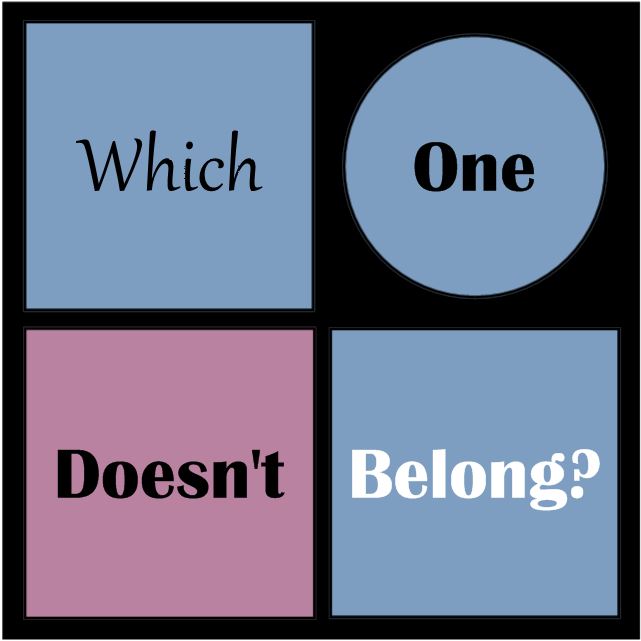
2. Which One Doesn't Belong is a website inspired by Christopher Danielson and created by Mary Bourassa. It features sets of four figures and simply asks: which one doesn't belong. Interestingly, each of the four figures might not belong depending on the context and rational provided. A seemingly simple question can introduce ambiguity and spark rich discussion from kindergarten through calculus.

3. In the past, I have seen very rigid interpretations of standards based grading that either (1) do not allow for the grading of homework, classwork, and larger practice-based tasks, or (2) are seemingly incompatible with a traditional A-B-C-D-F grading scale. Today I found a much more open interpretation that advocates: if it’s important for students to know and do, then make it a standard. That means that there could be a set of “scholarship” standards for good student skills such as completing homework and projects in a timely manner. There could also be a set of “problem solving” standards that highlight the 8 mathematical practices. Of course, these standards would account for a much smaller percentage of a student’s overall grade, but it is possible to incorporate them within a more open view of SBG. Thanks to Anna Hester, David Petersen, and Lisa Soltani.

4. A boring lesson in person is still a boring lesson on video. While creating flipped video lessons for students introduces the ability to predict, rewind, and re-watch, we must be careful not to push mounds of procedural blather onto students. Andrew Stadel suggests creating videos that are quick and to the point with off screen preparation. He also advocates for videos with errors; complete a problem incorrectly and ask your students to find the error. Princess Choi suggests that students create their own videos as a review strategy. Whatever the method, don’t make your videos boring!
5. Pump up your class. Give everyone a high five when they come in the room. Give neuron stickers when they help each other. Let students hit the gong in your class. Create varsity math t-shirts. Build rapport. Find something you love and do more of it. Be fast, fair, friendly, firm, and funny. And remember, you can’t learn from someone you don’t like.
6. Five miles seems shorter when running with other math teachers.

2. Which One Doesn't Belong is a website inspired by Christopher Danielson and created by Mary Bourassa. It features sets of four figures and simply asks: which one doesn't belong. Interestingly, each of the four figures might not belong depending on the context and rational provided. A seemingly simple question can introduce ambiguity and spark rich discussion from kindergarten through calculus.
3. In the past, I have seen very rigid interpretations of standards based grading that either (1) do not allow for the grading of homework, classwork, and larger practice-based tasks, or (2) are seemingly incompatible with a traditional A-B-C-D-F grading scale. Today I found a much more open interpretation that advocates: if it’s important for students to know and do, then make it a standard. That means that there could be a set of “scholarship” standards for good student skills such as completing homework and projects in a timely manner. There could also be a set of “problem solving” standards that highlight the 8 mathematical practices. Of course, these standards would account for a much smaller percentage of a student’s overall grade, but it is possible to incorporate them within a more open view of SBG. Thanks to Anna Hester, David Petersen, and Lisa Soltani.

4. A boring lesson in person is still a boring lesson on video. While creating flipped video lessons for students introduces the ability to predict, rewind, and re-watch, we must be careful not to push mounds of procedural blather onto students. Andrew Stadel suggests creating videos that are quick and to the point with off screen preparation. He also advocates for videos with errors; complete a problem incorrectly and ask your students to find the error. Princess Choi suggests that students create their own videos as a review strategy. Whatever the method, don’t make your videos boring!
5. Pump up your class. Give everyone a high five when they come in the room. Give neuron stickers when they help each other. Let students hit the gong in your class. Create varsity math t-shirts. Build rapport. Find something you love and do more of it. Be fast, fair, friendly, firm, and funny. And remember, you can’t learn from someone you don’t like.
6. Five miles seems shorter when running with other math teachers.

Thursday, July 23, 2015
Five Things I learned at TMC15: Thursday 7/23/15
1. Don’t give your students mathematical definitions. Instead, have groups of three or four students write a definition for a well-known mathematical idea or geometric figure on their own. Then, have each group pass their definition to the next group. Groups should now try to “break” their definitions by providing a counter example. Once they find a flaw in the definition, they refine the definition and continue passing the paper.

2. Here’s an idea for exit tickets. Make a grid with 3 by 3 inch boxes and write each of your student’s names in a different box. Place your grid on the wall near the door. Have your students complete their exit tickets on a sticky note, and stick them in their box on the grid as they leave class. This system makes it easy for students to hand in their exit slip and even easier for the teacher to grade. It is best used for reflective exit slips, as students could cheat on a skills-based or assessment-style exit slip.


3. Mathmistakes.org is a site is about compiling, analyzing and discussing the mathematical errors that students make. It is edited by Michael Pershan, a middle school and high school math teacher from NYC.
4. Manifold is an origami style game by The Incredible Company. It challenges players to take a small sheet of paper with scattered black and white boxes and fold it such that all the white boxes appear on one side and all the black boxes appear on the other. While it isn’t tied to any topic or standard, this is a fun activity in spatial reasoning that will either frustrate or leave you addicted.

5. Another game about spatial reasoning that will either frustrate or leave you addicted. Okay? is a simple iPad and iPhone app that challenges users to bounce a ball off a series of blocks in one shot. Best of all, you pay what you want for this app.

6. (Extra Credit) Dueling Piano bars are the best.

2. Here’s an idea for exit tickets. Make a grid with 3 by 3 inch boxes and write each of your student’s names in a different box. Place your grid on the wall near the door. Have your students complete their exit tickets on a sticky note, and stick them in their box on the grid as they leave class. This system makes it easy for students to hand in their exit slip and even easier for the teacher to grade. It is best used for reflective exit slips, as students could cheat on a skills-based or assessment-style exit slip.

3. Mathmistakes.org is a site is about compiling, analyzing and discussing the mathematical errors that students make. It is edited by Michael Pershan, a middle school and high school math teacher from NYC.
4. Manifold is an origami style game by The Incredible Company. It challenges players to take a small sheet of paper with scattered black and white boxes and fold it such that all the white boxes appear on one side and all the black boxes appear on the other. While it isn’t tied to any topic or standard, this is a fun activity in spatial reasoning that will either frustrate or leave you addicted.


6. (Extra Credit) Dueling Piano bars are the best.
Saturday, July 18, 2015
Five Things I Learned at PCMI: Friday 7/17/15
1. When you set goals, set them in stone. The RoP staff asked us to set goals for the upcoming school year as a result of our experiences at PCMI. They asked us to consider possible solutions to challenges we might face along the way. And then we made it official; we made and submitted a video of us explaining our goals to be reviewed later in the year. Although it is a bit awkward to create a video of yourself, I doubt I will forget my goals any time soon.
2. All of the afternoon working groups presented today. Our group presented Geometry Transformed, a webinar style professional development to help teachers transition to Common Core geometry, which relies heavily on transformations. There were also a number of other professional development resources presented, and I will be exploring them all very soon. Most notable were the presentations about growth mindset, the social dynamics of math discussion, writing in math, and a problem set from Ben.

3. Bowen Kerns demonstrated the math games at http://solveme.edc.org/. There is a Mobile puzzle that develops intuition for solving equations, a “who am I” game for number sense, and Ken Ken style puzzle that imposes higher order thinking on the basic operations. Each game also gives students the ability to make their own puzzle.
4. I learned how to transform an algebraic function if the rule is in this form: (x, y) -> (f(x), g(y)). I also learned about how permutation groups and symmetric groups relate to reflections and rotations of regular polygons. There are so many connections between geometry and algebra; you would think it was the focus of the conference. Wait a second…
5. The MAA held a "debate" over the relative merits of the transcendental numbers, pi and e, at the Family Weekend for Williams College in 2005. The debate is largely humorous, but does hide some important mathematical ideas. Thomas Garrity, who served as e's champion, was one of the faculty members at PCMI.
Part 1: https://youtu.be/whpAX30vjoE
Part 2: https://youtu.be/i1hYL0ccqm0
Part 3: https://youtu.be/DytqTMmi_os
Part 4: https://youtu.be/9CCBqinb744
Part 5: https://youtu.be/Xp_znceoeWo
6. (Extra Credit) The cheese and ice cream from Heber Valley Milk & Heber Valley Artisan Cheese is delicious. Two vans full of teachers drove down from the Zermatt to eat some ice cream and see the cows. I split the south west cheese curds with matt, and most of us walked back to the resort.

7. (Extra Credit) The people I have met at PCMI are some of the most amazing, thoughtful, dedicated, and human educators that I have ever met. Darryl and Bowen helped me remember the highs and lows of being a student again. The entire Reflecting on Practice staff facilitated sharing, discussion, and reflection about pedagogy. In my afternoon working session, Gabe and Jim gave me more insight into transformational geometry than I ever had hoped to have. Every single one of the participants at PCMI 15 was willing and eager to share their ideas both in and out of sessions. The entire three weeks served as an open forum for refining old ideas, gaining new ideas, and plenty of time in the pool.

On the last day, most of the TLP got all of the leftovers together for one last meal, one last volleyball match, one last hot tub, and one last late night card game. I hope to see you all again soon.
2. All of the afternoon working groups presented today. Our group presented Geometry Transformed, a webinar style professional development to help teachers transition to Common Core geometry, which relies heavily on transformations. There were also a number of other professional development resources presented, and I will be exploring them all very soon. Most notable were the presentations about growth mindset, the social dynamics of math discussion, writing in math, and a problem set from Ben.

3. Bowen Kerns demonstrated the math games at http://solveme.edc.org/. There is a Mobile puzzle that develops intuition for solving equations, a “who am I” game for number sense, and Ken Ken style puzzle that imposes higher order thinking on the basic operations. Each game also gives students the ability to make their own puzzle.
4. I learned how to transform an algebraic function if the rule is in this form: (x, y) -> (f(x), g(y)). I also learned about how permutation groups and symmetric groups relate to reflections and rotations of regular polygons. There are so many connections between geometry and algebra; you would think it was the focus of the conference. Wait a second…
5. The MAA held a "debate" over the relative merits of the transcendental numbers, pi and e, at the Family Weekend for Williams College in 2005. The debate is largely humorous, but does hide some important mathematical ideas. Thomas Garrity, who served as e's champion, was one of the faculty members at PCMI.
Part 1: https://youtu.be/whpAX30vjoE
Part 2: https://youtu.be/i1hYL0ccqm0
Part 3: https://youtu.be/DytqTMmi_os
Part 4: https://youtu.be/9CCBqinb744
Part 5: https://youtu.be/Xp_znceoeWo
6. (Extra Credit) The cheese and ice cream from Heber Valley Milk & Heber Valley Artisan Cheese is delicious. Two vans full of teachers drove down from the Zermatt to eat some ice cream and see the cows. I split the south west cheese curds with matt, and most of us walked back to the resort.

7. (Extra Credit) The people I have met at PCMI are some of the most amazing, thoughtful, dedicated, and human educators that I have ever met. Darryl and Bowen helped me remember the highs and lows of being a student again. The entire Reflecting on Practice staff facilitated sharing, discussion, and reflection about pedagogy. In my afternoon working session, Gabe and Jim gave me more insight into transformational geometry than I ever had hoped to have. Every single one of the participants at PCMI 15 was willing and eager to share their ideas both in and out of sessions. The entire three weeks served as an open forum for refining old ideas, gaining new ideas, and plenty of time in the pool.

On the last day, most of the TLP got all of the leftovers together for one last meal, one last volleyball match, one last hot tub, and one last late night card game. I hope to see you all again soon.
Friday, July 17, 2015
Five Things I Learned at PCMI: Thursday 7/16/15
1. I learned a great deal from Dylan Williams. See the full
post here: http://mrjanesmath.blogspot.com/2015/07/dylan-williams-at-pcmi.html

2. Chris introduced me to a question structure for inquiry. After
students have become familiar with a problem, scenario, or task, they should be
asked to generate at least one or two questions in each of the following categories.
Level 1 questions are questions that they know the answer to, level 2 questions
are ones that they don’t know the answer to but have an idea of how to approach
it, and level 3 questions are ones that they don’t know how to approach. All
three levels are important. It might seem trivial to write down questions that
students already to know the answer to, but it is important to parse out what
information is known and what is unknown. Besides, it also helps validate
student thinking. Chris also noted that throughout the activity, questions
should be moved from one level to another as they are answered, or more insight
has been achieved.

3. We discussed “My Favorite No” today. I’ve seen this
before, but I want to incorporate this in my class. Rather than boring you, let’s
go straight to the source: https://www.teachingchannel.org/videos/class-warm-up-routine
4. We have also discussed 5-Practice Routines for the past
two weeks, but now is a good time to bring them up. Again, the source a la
Christopher Danielson: https://christopherdanielson.wordpress.com/2011/08/26/five-practices/

5. Marty talked to me about The SimCalc Project at UMass
Dartmouth. The objective of the project was to create software that allows
students to collect data on computer simulations relevant to algebra and
calculus classes. The software and curricula are now available online for purchase:
http://www.kaputcenter.umassd.edu/products/.
However, Marty cautioned that other programs that used more hands-on
simulations and data collection had more success. I’m not teaching calculus
next year, but I’ll pass this one on to my colleague who is.
6. (Extra Credit) Beth A Herbel Eisenmann is a mathematics
education researcher at Michigan State University who focuses on promoting
student discourse. Her book Promoting Purposeful Discourse was recommended to
be by a colleague at PCMI.
Subscribe to:
Posts (Atom)